Thursday, April 02, 2009

Roy Rogers Fast Food


It was started by Marriott in 1968 in Falls Church, Virginia. To be honest, it had very little to do with a cowboy star, except that the company paid him to use his name.

The menu included burgers, roast beef sandwiches, fried chicken, and a lot more. Roy's picture was everywhere.

There used to be several outlets in Southern California. But it always was an East Coast chain... only those of us who lived on the other side of the country never realized that. For some reason (and I've looked everywhere) the chain suddenly disappeared from the face of the West Coast in the early 1980s.

It was a tremendous shock for me, when the Army sent me to Fort Dix, New Jersey, to find a Roy Rogers hamburger stand in nearby Wrightstown. It's gone now, since the nearby post was taken over by the New Jersey National Guard. But you can still find Roy Rogers in the area.

Even in Times Square, New York City.

Kenny Rogers Roasters


Kenny Rogers began his Roasters restaurant chain in 1991. Within four years the restaurant had locations in Asia, including Indonesia, the Philippines, Singapore, Malaysia, and other countries.

Sadly, there is only one Kenny Rogers Roasters location in the United States, at the Ontario Mills Mall in Ontario, California, not too far from my home town of Colton.

I now live in Cagayan de Oro in Mindanao, in the province of Misamis Oriental, the Philippines. We don't have a Roasters. The nearest one is about twelve hours south (by bus) in Davao. Besides the Philippines, they still have locations in Indonesia, Malaysia, and Singapore. They are also in Brunei and China and will soon be in Dubai and Australia.


Cucamonga, California


Cucamonga was a real place that ceased to exist when it incorporated in 1977, joining the other unincorporated communities of Alta Loma and Etiwanda. Since it took the name Rancho Cucamonga, the former Cucamonga handle was completely forgotten.

It was famous for wine. All but one of the vineyards are gone. Today it's a residential, retail, and light manufacturing area. The Metrolink commuter train station, near the Epi Center baseball park for the Rancho Cucamonga Quakes (of the California League) is on Jack Benny Drive...

"Train leaving on Track Five for Anaheim, Azusa, and Cu-ca-monga!"

TV Editorials...


Remember the days when the news would end five minutes early so some old guy would tell you how he felt about something that didn't make any difference to you?

Boy, I sure miss those days.

This is a picture of Van Sauter, who used to give editorials on Channel 2 in Los Angeles several times a week.

Foremost Milk


Foremost began as a project of James Cash Penney (JC Penney? Right!) Foremost was actually the name of his prized bull, Langwater Foremost

Foremost became a national dairy in the 1950s with Foremost milk being sold in all 48 states, plus three territories (Alaska, Guam, and Hawaii.) 

Today Foremost milk is sold by several companies using the name. There is a Foremost Cooperative based in Wisconsin. There is a Foremost Dairy working out of the Coca-Cola plant on the island of Guam. In California, Foremost milk is produced by Heartland Farms. And Foremost milk is also sold in Malaysia, the Netherlands, and many other countries around the world by Friesland Foods.


World Trade Center - - NYC


I lost friends there. 

Mirafone Tubas


Miraphone was one of the first German musical instrument companies that surfaced after the end of World War II. Using patterns from pre-war German and Czech (Czechoslovakian) tubas , the company began in Bavaria in 1946. 

They looked for a market outside Germany. In the late 1950s, they looked to America. This was the time when Tommy Johnson (1934-2006) began playing for many cartoons and television shows in Hollywood. So working with the Lockie Brothers (which distributed foreign musical instruments), Tommy became the company spokesman and was featured in a few of the magazine ads.

The spelling of Miraphone was changed to Mirafone for the American market. Mirafone had warehouses in Downtown Los Angeles and the Sun Valley neighborhood of L.A. before moving to Santa Clarita (Valencia), California, in 1990. Then the outlet was sold to a Netherlands percussion company and moved to suburban San Antonio, Texas. A few years later, Miraphone stopped with the idea of having a warehouse in the United States and did all its work from Waldkraiburg, Germany. 

My fellow tubists argue with me (I own a 1962 Mirafone 186-5U CC) but I think there is a difference between the Mirafone and the Miraphone tubas. But no matter now... they only make Miraphones now.

Miraphone's website.

Busch Gardens (Los Angeles)

Anheuser-Busch (makers of Budweiser, Michelob, and Busch beers) opened a brewery in the Van Nuys section of Los Angeles in 1954.

Twelve years later a family amusement park was put in with the beer making stuff.

Busch Gardens lasted just a few years. Its great magnet was the offering of free beer. All the beers that Busch made could be had just by showing a driver's license (for anyone over 21 years of age.)
Supposedly the kiddies were supposed to have fun. But I'm sure the ride home was hellish. 

Hoffy's Hot Dogs


Hoffman Brothers was one of the greatest meat companies in Los Angeles. They made terrific hot dogs and bacon. But the message of how great their meat was wasn't getting out.

So, in the 1970s, they hired Pat Boone as the company's comercial spokesman. In Los Angeles they surpassed Oscar Mayer, which had been the leader in hot dogs, thanks to national advertising.

But Pat got into other things. 

You can still buy Hoffy's hot dogs at most Los Angeles area supermarkets. But Hoffy's best are not available to the general public, except as prepared hot dog sandwiches served at Pink's in Hollywood. These are the kind with a natural skin... the kind that crunch when you bit into them!

New Coke

Do you remember this? In 1985, after being beaten mercilessly by Pepsi Cola's marketing techniques the folks at Coca-Cola had the wild idea that they should make their drink more like Pepsi.
Coke's formula was virtually unchanged since the amount of coca leaves was diminished early in the twentieth century. But Coke was suffering. So they all threw their hands up and came up with a new product which wasn't as good.
Sales plummeted. Less than three months later, Old Coke (now called Coca-Cola Classic) reemerged on the shelves. 
Did you know, they kept New Coke (later known as Coke II) on the market until 1990?
By the way... For those of you who say there is no difference in Coke and Pepsi: Coke has an overwhelming flavor of lemon juice. In Pepsi, it's cinnamon.

California Baptist College


It began as a small school on the grounds of the First Southern Baptist Church in El Monte, California in 1950.  In 1955 an old folks' home in Riverside opened and it became the campus of California Baptist College. For years, they offered only Bachelor of Arts and Bachelor of Science degrees in a number of subjects. After about thirty years in existence, they offered a Bachelor of Music degree (known as the LBM, the Long Bachelor of Music program, since most students couldn't do it in less than five years.)
After dropping out of college in 1978, spending seven years in the US Army, I entered Cal Baptist (CBC) in Spring Semester 1986. I graduated with the Bachelor of Music degree in Tuba Performance in 1989. I believe I am the last person to have earned that degree. It was eliminated a few years later. 
For years the college had been trying to get bigger. We always seemed to have an enrollment of 666 students, not a good number for a Christian university. In the 1990s, a new president was elected to head the institution and eventually the name was changed to California Baptist University. Today there are over 4,000 students and, while it does not offer a Bachelor of Music, it does offer a Master of Music degree... and about 20 other graduate degrees.
As far as the changes, for a family man struggling to get through college, I liked the older school better. It helped me to grow up with a small, tight knit community, with whom I wasn't always so afraid to make mistakes.  
I didn't go to CBU. I went to CBC.

Dressing up to go out

There was a time when, if you wanted to go out, you had to dress up. Even if you were going on vacation, whether you were a passenger on an airplane or a train, you had your traveling suit (most people had two or three). I can remember seeing people in 1963 wearing curlers at the supermarket (I was five or six at the time.) I thought that was absolutely rude.

Why did people dress that way? It goes back to our rural roots. We'd dress down to stay home and dress up to go out. No one wanted to see what we wore at home when we were shopping, even if we were just going out to get a couple of onions and a half gallon of milk.

With the urbanization of America, we began to dress down a lot more. The hat industry suffered. Did you know there was a time when you didn't go out unless you were wearing a hat? I usually do wear a baseball cap when I'm out today. But that's not exactly what you call dressing up to go out. That's play clothes.

Wednesday, April 01, 2009

Master Charge

As I have often said, "Name changes don't happen for nothing." A credit card began in 1966 as a competitor for the BankAmericard. It was the official credit card for a group of banks known as the Interbank Card Association. The banks included:
Bank of California
Crocker National Bank
United California Bank
Wells Fargo Bank

All of these banks were in California. The credit card was Master Charge - - the Interbank Card. In 1974 banks from other parts of the country were added. The name was changed to Mastercard when the card became international in the 1990s.


Montgomery Ward

Aaron Montgomery Ward (1844-1913) published the world's first mail order catalog in 1872. Thirteen years after his death, the mail order business became a retail store. Although Sears Roebuck copied Ward's idea of a catalog in 1896, Ward's would struggle for the rest of it's existence as a sales business by its competition with Sears.

Ward's stores started in 1926. The company was very big with private brands (Skips sneakers, Airline electronics and musical instruments, Brent men's clothing, Hawthorne bicycles, etc.)

Ward's (later Wards) was the first retailer to use the expression:

----------------------Satisfaction guaranteed or your money back.

By 1883, Ward's catalog was known as the Wish Book. Sears would later copyright that term for that company's use.

Rudolph the Red Nosed Reindeer, the story and the song, were both written for Montgomery Ward promotions in 1939 (the song in 1948 by Johnny Marks).

The company had several owners from the 1960s on, including Mobil Oil and General Electric. It was General Electric which suggested liquidating the company in 1999 and putting the whole thing up for sale.

In 2004, five years after the original company went out of business, the Wards name was put onto an Internet business at wards.com.

CBS Radio Mystery Theater


It started on New Year's Day 1974. The host was E.G. Marshall. CBS was the last network to have regular radio drama. The last shows CBS aired as part of the Golden Age of Radio were Suspense and Yours Truly, Johnny Dollar, in September 1962.

Himan Brown (born 1910), who had done many radio shows was in charge of its production. For most of its run, the CBS Radio Mystery Theater aired seven times a week.

As a soldier, I never got to listen to it when I was in basic training (we went to bed before 8:30 at night and never thought of anything like radio). I heard it when I wasn't busy at the School of Music (Little Creek Naval Amphibious Base) for my advanced training. My two roommates would always enjoy it. When the Army sent me to West Berlin, everyone listened to it. It came on at 6:00 on AFN (American Forces Network) Berlin. They also played other current programs such as the Bob and Ray show that was playing on NPR (National Public Radio) at the time. After all that, then we got to hear four hours of Old Time Radio. I treasured everything I heard.

Actually, my best recollections of the CBSRMT were when I was a high school student. We had two choices to listen to it: It first came on KNX (1070 kHz, Los Angeles) at 9:00, just before they had an hour of Old Time Radio. It also came on at 11:00 on KPRO (1440 kHz, Riverside... this wasn't the same KPRO station on the air today) just before it went off the air. The family usually opted for the later broadcast and the five of us had four radios (my parents shared one) and we all went to sleep as the Radio Mystery Theater gave us a bedtime story.

Family togetherness.

German Democratic Republic


I was stationed with the 298th Army Band of the Berlin Brigade from October 1979 to January 1982 as a tuba player. For an American soldier in his first assignment, it was a most unique one. We couldn't do our duties until we finished School of Standards classes. And those classes filled up quickly. My class wasn't scheduled until a week before Thanksgiving, so the only work I was allowed to do before that time was rake leaves or be a relief guard (charge of quarters) at night.

The band had gone to Moscow (Soviet Union) for a few days. There were only a few people who could work as charge of quarters. I raked leaves from about 8:30 AM to 11:30 AM and 12:30 PM to 3:30 PM. As soon as I raked a pile, the wind blew more down. It wasn't much of a job but it kept me busy. It was steady, predictable, and the weekends were free.

My first weekend, I bought a day ticket on Saturday that was good for all of the U-Bahn trains (subway). I picked up a system map and planned all the places I was going to see. I didn't have a guide book or anything. I've never been to scared to explore a new place. My plan was to get off at every station and get off, exploring the place thoroughly.

Everything went well until I got off at the Friedrichstraße station. Things looked very strange. The police didn't look like West Berlin police. I saw uniforms I hadn't seen since I had ridden the American Duty Train from Frankfurt am Main. I was now in EAST BERLIN!

Now it wasn't forbidden for me as an American soldier to be in East Berlin. There were certain rules I had to follow: Either I could have a pass and wear my dress uniform (without a name tag) or I could be on leave with leave orders, a passport, and the proper visa and NOT be in a uniform. I didn't have either of those. I was wearing a blue Pendleton wool shirt, Levi's jeans, hiking boots, and a Greek seaman's cap. My identification was my Army ID card.

Shortly after I got to the station, I felt really bad and had to go to the toilet. I looked around and saw those beautiful letters: WC. Once finished, I heard a train going the other direction. I paid the washroom attendant the fee in West German marks (which was allowed) and headed back home.

Looking at the map when I got on the train, I saw the Berlin Wall was well marked but I was too stupid to know what it was. Rather than finish my "tour" I took a train to Kufürstendamm where I went to Burger King and ate two Whoppers.

Later, I would spend lots of time in East Berlin, but I never told anyone about my first trip until after I was discharged out of the Army, after 1986. I was so scared something would happen to me.

Now that I look back at it, I'm surprised I didn't get in trouble.

Victoria Guernsey


Here's a bit about my past:

When I was born, I was born in Riverside, California, but my parents lived in the neighboring community of Sunnymead (which is now part of the city of Moreno Valley... like many things in my life, much of where I lived isn't there anymore... which I personally find fascinating!)

My dad worked in migrant agriculture, working for the Davis Brothers Produce Company. He moved wherever the potato crop was going.

The moving got to be too hectic for him, so after my sister was born in December 1958, he was given a job that would keep him in one spot, the Victoria Guernsey Dairy in San Bernardino. There were actually two dairies. One was on Base Line Street in Highland. The other was at the corner of Ninth Street and Waterman Avenue. He worked at the latter and they let us park our trailer house there. As a toddler, I spent a lot of time on the fence behind my house, watching calves get born. My dad often took me with him on trips he made in a huge International Harvester combine truck, which was used for everything from feeding the cows, to picking up orange juice at the Vita-Pakt plant in Covina, to taking cows that wouldn't produce milk to the slaughterhouse. Yes, I did get to see the cows get killed. I still remember what I saw. And, no, I'm not a vegetarian.

Dad got tired at being at the beck and call of the dairy. When a job for experienced workers were called for the Santa Fe Railroad in 1961, the first thing he did was go to the hardware store and bought every tool the job announcement said he was supposed to have, plus a toolbox. Then he left the tools out in the rain one night to get some "patina." The next morning, he carefully dried them, but they didn't look new anymore. He went to the interview with his toolbox and was one of the first men hired.

At first, we moved to Corona (which neighbors Riverside) and he lived during the week in an outfit car (an old passenger coach turned into a rooming house) in San Diego. Later, we moved to San Diego, where my brother was born in 1962. (We lived there from late 1961 to August 1962... then we moved up the road to Oceanside...)

So now you know more about my past...

Victoria Guernsey quit producing milk in the early 1970s. The place where my family used to live became a Kmart store in about 1973. Then it went out of business and many businesses have occupied that spot since that time...

Phone Booths

Do you remember phone booths? I was probably the last person on the face of the earth to get a cell phone, which actually coincided with my ex-wife suing me for divorce. I can remember how difficult it was to look for a working pay phone...

When I lived in Indonesia, there were two kinds of phone booths... the kind that took coins and the kind that took phone cards. The card type were always easier to use because you never knew how long your 5,000 rupiahs was going to last for a call.

Living in California, having a cell phone made sense. When my Volvo broke down in the middle of the desert, for example, I didn't have to get out of the car and walk a 30 mile round-trip to the nearest Shell station to get a tow. No, all I had to do was get my cell phone and my Automobile Club card. I could get back home, refreshed and not exhausted.

I don't know why I didn't get a cell phone earlier.

Phooey on phone booths.

7up Gold


I'm probably the only guy that liked this stuff. It came out in 1988. It was called "spice soda." When I lived in Berlin, Germany, it was my tee-totaller days (yeah, I know... bummer living in Germany and not being able to drink beer!) But I loved the German soda pops! They had something called Kreutzer, which had a very unsweet flavor. (For those of you know don't know, except for cola and some chocolate, I'm not too fond of sweet things, except pretty young women! I prefer savory.) This stuff was great.

Some 7 Up purists didn't like the fact that this stuff had caffeine (more than Coca-Cola) and you couldn't see through it.

When word came out late that year, I tried to buy up as much of the stuff as I could afford. Alas, when it was over I went back to drinking my Coke.

Pay TV

This was a precursor to such services as HBO and Cinemax. It worked like this: You wanted to watch uncut movies at home. And this was long before low priced videocassettes had been introduced. You called up one of the Pay TV providers. The Los Angeles area had three...
  • Z-Channel (began in 1974, used a low power channel... not available outside Los Angeles)
  • ON-TV (began in 1977, used facilities of KBSC-TV, channel 52, in Glendale)
  • SelecTV (began in 1978, used facilities of KWHY-TV, channel 22, in Los Angeles... in 1984 it merged with ON-TV and broadcast on channel 22)

Charges were $19-25 a month (more if hard core pornography was desired). At first, channels 52 and 22 showed their regular programming and at 7:00, the picture would become scrambled, prompting subscribers to turn them on and watch movies until the next broadcast day began at 6:00 AM. In the wee hours, there would be another scrambling of the picture, for the porn subscribers.

In the movie. American Pie (1999), one of the characters is seen trying to watch scrambled movies. It was pornography on over-the-air pay television. Now you know.

Pay TV ended in 1991, when everyone started getting cable.

Sambo's


Started in Santa Barbara, California by Sam Battistone and Newell "Bo" Bohnett, it was named "SamBo's" after themselves. Soon it became tied up with the story of a dark skinned boy who liked to play with tigers. Pictures depicting this story were placed all over the restaurant.

Other Sambo's began to appear all over the country. At their height, in 1979, the chain had 1,200 restaurants in 47 states.

But some groups viewed the Sambo name as being pejorative. New stores couldn't be built because the local governments wouldn't let a racist name like that be used in their community. The company began losing money fast. They tried a couple of name changes for new outlets: The Jolly Tiger and Sam's. But nothing worked. Bankruptcy happened very quickly.

By 1982, only one Sambo's was left... the original one at 216 W. Cabrillo Blvd. in Santa Barbara. And it remains open today.

For those who didn't know, while the chain went out of business, the restaurant itself never shut down!

Earp House, Colton, California


Virgil W. Earp and his wife, Alvira ("Allie"), lived in his parents' house (Nicholas P. Earp and his step-mother) at what is now 528 West H Street in Colton, California, not far from the campus of Colton High School. The house is still used (by a different family). Nicholas was Justice of the Peace and Virgil ran a small private detective agency. His brother, Morgan S. Earp, who was killed in the Gunfight at the OK Corral, is buried at Hermosa Municipal Cemetery at the corner of Meridian Avenue and C Street. Virgil was the first marshal of the City of Colton when it became incorporated in 1887. The house was one of the first with electric lights. The family would move on but the house still exists. And functions.


Tuesday, March 31, 2009

Pic 'n' Save

After moving to the Riverside-San Bernardino area (real natives from that neck of the woods don't say "Inland Empire!" It sounds like you're trying to sell something) from Oceanside in 1966, we often went to a store in Fontana (which was on the site of a recently closed McDonald's Supermarket--no relation to the fast food chain). This was a store that sold things other stores couldn't sell. And this store had something else... FREE STUFF! I remember getting finger puppets that were absolutely free, even if my parents didn't buy anything!

The store, later I realized, was part of a bigger chain. Over the years, I came to appreciate it. I could get almost anything I wanted for pennies.

When I moved to Texas in 1989, I was surprised that there were several Pic 'n' Save stores in the Fort Worth area (I also refuse to say Metroplex!) But for some reason, after about a year, the store name was changed to MacFrugal. Nothing about the store had really changed except the name...

But remember this: Name changes never happen for no reason! What happened was there was a Pic 'n' Save chain in Florida and this cleared up the confusion of two chains with the same name. Never mind that there weren't any other Pic 'n' Save stores in Texas (that I knew of) besides the one chain I knew from California. Outside California, Pic 'n' Save was MacFrugal.

Fast forward about fifteen years. I was back in California and started noticing the signs were changing. Now it was Big Lots! This was more than just a name change. It marked the beginnings of a merger with a store chain from back East and this chain promised not to sell any junk. For that, you have to go to the 99 Cents Only Store or Dollar Tree.

Sigh!

Riverside's Osteopathic Hospital


I went to Google to look for 4295 Brockton Avenue. It's my birthplace. It was Riverside's Osteopathic Hospital until about 1961, when it became a psychiatric clinic. Years later, when my family moved to nearby Colton, it had become a secretarial college. That's what it was when I left California in 2006. It's also been the site of a bail bonds office. I don't know what it is now.

As a hospital, it was very small. There wasn't even a physician on duty. I was born at 1:15 AM, it was Saturday, but, to my parents, it was still Friday night.

For those who don't know, an osteopath is a physician who employs some chiropractic techniques. Most of my doctors have been osteopaths, but I've only known them to use "normal" medical practices.

Incidentally, Riverside, even though it's the largest city (312,000) of Riverside County, California, doesn't have very "urban" sounding house numbers. The hospital was located in the middle of the city.

Rooftop TV Antennas


Originally, cable television was for people who lived too far away from a local TV outlet to receive it with an antenna. Consequently, Barstow, California, had cable long before Los Angeles, Chicago, or even New York City!

As a student at Tennessee Technological University, living in the dormitory, a cable box came free with the room. Without it, the only channel we could pick up was WCPT-TV, channel 55, in Crossville. That station has long since left the air (1983). We didn't have any "premium" stations. We couldn't even get WTBS in Atlanta (today's TBS). But we could get two of the three network affiliates in Knoxville, most of the stations in Chattanooga, the lone ABC affiliate in Bowling Green, Kentucky (site of then arch rival Western Kentucky University), and everything that came on in Nashville. Since we were on the dividing line between the Central and Eastern Time Zones (but living in the Central), we had to think of the clock accordingly. The 6:00 news on channel 9 (ABC) in Chattanooga came on at 5:00 in Cookeville.

A few years later, the movie channels were added then the special interest channels. Today it's possible to watch everything on TV and never watch anything airing on the local stations. Since the channels can show nothing but commercials, it's not really worth watching most that comes over the air...

I can also tell you about how, in the 1970s, when there was a tropical storm in the Pacific Ocean somewhere off the coast from Los Angeles, we could get some amazing "skips." I can remember watching something on KNBC, channel 4 (Los Angeles) in 1975. The wind blew and we were watching a news broadcast from somewhere in North Dakota. The picture was absolutely clear! You can't get that with cable!

Ken-L-Ration Dog Food


My dog's bigger than your dog;


My dog's bigger than yours!


My dog's bigger


'Cuz he gets Ken-L-Ration;


My dog's bigger than yours!

North Oceanside Elementary School


When North Oceanside Elementary School was built in 1939, it was a state of the art school with everything every school is supposed to have. It was my first school I went there from September 1962 (Kindergarten) until May 1966 (third grade), when we moved to Colton (next city to San Bernardino, but not far from my birthplace, Riverside).

Let me interject a sidenote here: The day after we settled into the Mount Slover Trailer Village in Colton, my mother was curious and went to the offices of the Colton Joint Unified School District to ask when school started in September. But school was still running... it was still running in Oceanside, too. The administration knew that some schools outside California have school years that end sometime in May. So they promoted my sister and me four weeks before the school year was over. But when they knew we were public school students, sitting at home, doing nothing except watching Sheriff John, they told us to go to U.S. Grant Elementary School as soon as possible. We still had three more weeks of school left! Bummer...

For the students at North Oceanside School, this would be their last year. The school was to be demolished to put in a new freeway to bypass Mission Avenue (California State Route 76). They would go across the San Diego Freeway (I-5) to North Terrace Elementary School.

We didn't keep much in contact with old friends in Oceanside and soon forgot them. But we'd go to Oceanside on the weekends... they had a very decent beach with no charge access. Parking was under $1.00...

Strange, we often went by the old school and nothing happened! It was closed but all the buildings were still standing, something like a ghost town!

Time passed by... I graduated from Colton High School in 1975... I went to three different colleges before dropping out in 1978... Then I joined the Army in early 1979, and was honorably discharged seven years later... I graduated from college, moved away to Texas for graduate school and work... I came back... And we'd go to the beach in Oceanside and nothing happened to my old school... until...

1995, we saw some earth moving equipment on one of our beach trips. About a year after this, we saw what you see at the top of this posting. My old school is where you see the palm trees on the right side. I think one or two buildings are still there. And it really wasn't a freeway... It is the San Luis Rey River Expressway. It has intersections and not on/off ramps.

Just think, it only took thirty years!

Monday, March 30, 2009

Earth Shoes


Remember these? The toe was higher than the heel. And I actually owned two pair of them!

Helms Olympic Bread

"Toot! Toot!"

I remember the Chevrolet panel truck driving in the trailer parks I lived in, both in Oceanside, and Colton, California. It was a mobile bakery shop selling many varieties of breads, cakes, donuts, and pies.

Now maybe the Helms man is partly the blame for my type-II diabetes. After the driver/vendor was done with his route, he offered the kids all the donuts they wanted. He said otherwise, the truck would be full of ants and it saved time cleaning up the truck. I think each of us received 10-15 donuts, which we stuffed into our faces at once. Right after this it was dinnertime and none of us felt like eating!

Helms started in 1932. They were one of the sponsors of the Los Angeles Olympics in 1932. They provided white and whole wheat bread, as well as other bakery goods, in the Olympic Village. They were the bread providers for the US Olympic teams in 1932 (Los Angeles), 1936 (Garmisch-Partenkirchen and Berlin), 1948 (St. Moritz and London), 1952 (Oslo and Helsinki), 1956 (Cortina d'Ampezzo and Melbourne), 1960 (Squaw Valley and Rome), 1964 (Innsbruck and Tokyo), and 1968 (Grenoble and Mexico City).

The founder and CEO of the company Paul Helms died on January 5, 1969. The company struggled to survive. But they managed to do a few gimmicks...

They provided bread for the Apollo 11 lunar mission (July 20-24, 1969). This was the first lunar mission and Helms was the first bread on the moon...

Sadly, though, by the time the astronauts came back to earth, the Helms Bakery was out of business...


Deposit Bottles


If I remember correctly, 6-16 ounce bottles were five cents, 26 ounce bottles were ten cents, and Mother's Pride (1 quart, the biggest size before the advent of PET containers) bottles were fifteen cents. In 1973, when the Colton High School Yellow Jacket Marching Band was raising money for our summer European tour, we raised a heck of a lot of money from collecting pop bottles from many of the citizens of Colton and Grand Terrace.

Remember what supermarkets looked like then? Just past the front doors were baskets and baskets of dirty returned empty bottles.

In October 1979 I left California for Berlin, Germany, for duty with the Berlin Brigade (298th Army Band) of the United States Army. At the PX and Commissary, all of the American soda pop was sold in 12 ounce cans. They said that's the way it always was and I was accustomed to it.

But when I returned to California in 1982, it didn't look any different than the US military stores in Germany. There was a huge void in the supermarkets. No deposit glass bottles. In time the space would be occupied by plastic bottles, but this marked a new era in beverage history.

25 years later, when I was living in Saigon, Vietnam, I bought some Tiger beer at the local supermarket in glass bottles. The price marked was 12,000 dong (about US $.80 then). But the cashier charged me 14,000 dong. The reason? I had to pay a 2,000 dong (12.5 cents) deposit. My girlfriend had left a lot of beer bottles in the house. So the next time I went to buy beer I took seven bottles to the store and didn't pay anything!

Citizens' Band (CB) Radio


Breaker, breaker, one-nine...

This is Gassy Weasel...

I'm looking for a friendly soul today...

Give me your 10-20, but don't give me an 8-1.

I'm just looking for some jaw jacking. Maybe we can meet up the road for a cup of Joe.

Isn't there anyone on the air?

I don't hear anyone...

This channel is dead!

Forget it. If anyone wants to txt me, my cell phone number is...

Ponderosa Ranch


I loved the Bonanza TV series (NBC, Sunday nights, 9:00 PM/8:00 PM Central/Mountain, 1959-73). Here was a Western with very few cowboys... the Cartwrights were ranchers. In 1966, a theme park based on the series was put up in Incline Village, Nevada, overlooking Lake Tahoe (it wasn't far from Carson City or Reno). I went there in April 1975 and August 2004.

The ranch was great. It looked just like the TV show. I especially liked the family house (pictured here). I've often told people I want to build a replica of this house but I know I can't really have it.

It was the only theme park I know of that had its own line of liquor, a working saloon, and a working gambling casino... Heck, this was in Nevada. All those things are legal for adults past their 21st birthday.

I can't say much about the first time I went there but the second time I went with my (soon to be ex) wife and my parents. We took a week long vacation together in my parents' car. It was a bittersweet trip. My dad died shortly after my marriage of 20+ years ended in divorce.

And the Ponderosa shut down on September 27, 2004, my dad's 77th birthday...

Sunday, March 29, 2009

Hoagy's Petting Zoo

It was a pet shop with a zoo in the back of it. Located near the Rohr Aircraft plant (now Goodrich Aviation) in Riverside, California, you could buy exotic animals there (until the Humane Society deemed that animal to be unfit to live with humans).

The truth is I really don't know what happened to this place. I was last there when I was in junior high school. It was a lot of fun. I discovered I don't like unsalted peanuts (that's what was given to the elephants there).

I would love to hear from anyone who remembers Hoagy's Petting Zoo. The picture I selected for this page really doesn't do anyone any justice.

Farrell's Ice Cream Parlour


I remember the Farrell's in Riverside, behind the Tyler Mall (corner of Magnolia Avenue and Hughes Alley). It just wasn't a good place to eat ice cream... the Reuben sandwiches... the unique soda pop from years gone by...

In time that Farrell's became England's Ice Cream Parlour. It became independent. Then I went off to join the Army and spent a few years in Germany. I came back AND IT WAS GONE...

The Farrell's chain survived many years after this. However, today there are only three left... One is in Santa Clarita (north of Los Angeles) and the other two are on the island of Oahu in Hawaii.

If you are using the information I put in my old website about one being in San Diego... that one went out of business 3-4 years ago!

Typewriters

A little girl got excited when she saw the office device pictured at the left:

"Look what I found, Mommy. It's a computer. But it doesn't have a CPU. The keyboard is built into it. It has its own printer. And there is no monitor.

"Wow! it sure looks a lot nicer than Daddy's Macintosh Pro!"

ZZZZ Best Carpet Cleaning


Barry Minkow was a whiz kid. He got a few household supplies and started cleaning the carpets in his Los Angeles neighborhood when he was 16. He got to be so good he started advertising on TV and became wealthy at a very young age.

He was shown to be a model kid. Everyone was so proud of him. But he got involved with the wrong kind of people and money laundering. Eventually, he wound up in prison.

Today he works to help people understand that you cannot survive without being honest to anyone, especially yourself.

San Bernardino Valley College Indians


I was a student at Valley College in 1975 through 1976 and again in 1982. I played with the pep band, as the marching band had been disbanded two years before. We were the Indians. SBVC had been the Indians since 1927. The original nickname was the Wrens. It seemed strange to me then that the original nickname had been the wrens... I never saw any wrens. But it isn't that silly a thing... there are many wrens in the nearby desert...

Founded in 1926 as San Bernardino Valley (Joint) Junior College, Riverside Junior College (later known as Riverside College, Riverside City College, and now Riverside Community College) was twelve years older. Valley was always a bigger school with impressive athletic teams and bands. (The Valley College marching band was in the Tournament of Roses Parade long before RCC (Riverside Community College) even thought about being in it.

My band director at Valley was C. Paul Oxley. He was there from the 1950s through the 1980s. A studio trombone player in Chicago, an Army musician during World War II, and a high school band director in Tennessee, I owe a lot of my musical knowledge to that man.

In 2000 the students at Valley College voted to change the nickname of the school to Wolverines. Now wolverines don't even live in Southern California, except in zoos. The reason given for the change was that the term Indian was a pejorative term in describing the people who lived here before white people. Christopher Columbus called the people he saw Indians because he thought he was in Asia (and that's what they called Asians then).

No matter, in 2004, the entire musical program was wiped out so I wouldn't go back to that school today.

One thing many people against the Indians nickname protest is that the nickname demeans Native Americans. Arcadia High School in Arcadia, California, is the Apaches. For many years they abused that name. But in recent years, everything they do is approved by the tribal council of the White Mountain Apache Tribe of Arizona.

There are those who say there are no Caucasian school nicknames. Here are five. I'm sure you can come up with more. I linked the schools. Enjoy...

Saturday, March 28, 2009

Continental Trailways


There are people who will tell you that Continental Trailways didn't go out of business... it just got smaller.
It actually started out in 1936 as the National Trailways Bus System, a loose knit group of regional bus companies that could get people from one end of the country to the other. In time there were the local companies and the national system. They were the worst competition Greyhound had.
In 1987, the company (Continental Trailways, not the other Trailways companies) were taken over by Greyhound.
The thing I remember that they didn't go on the same routes. They went to Cookeville, Tennessee (Greyhound didn't, until 1987!) They had very unique buses. And the drivers drove a lot faster!

Betty Crocker Coupons


They came on everything that General Mills sold, even sponges and mops when the company manufactured cleaning supplies! First introduced in 1929, they were a way that household supplies and gadgets could be sold by mail at a savings. The big thing was Oneida pots and pans. You could also get some unique General Mills brand merchandise, like Cheerios bowls.


The coupons had expiration dates many years into the future. The Betty Crocker Catalog went out of business in August 2006 with everything in it being liquidated, with the coupons working until December 15, 2006, even though they had a date printed on them in 2012!


In 2007, the whole program was put online, though it isn't done through General Mills, but another company. Its website is here.

Cabazon, California


When you go from Los Angeles on I-10 and go past Beaumont and Banning in Riverside County, you will come across the town of Cabazon. It's on the right side of the freeway. If you are looking, you will probably look at the huge buildings on the left side of the freeway. The two outlet malls. The gambling casino. And the cheap gasoline. That's part of the land owned by the Morongo Band of Mission Indians. They get a lot of money on that stuff.


Going further, you will see some life size models of dinosaurs, which were made famous in the movie, Pee Wee's Big Adventure (1985), starring Paul Reubens. Those are Claude Bell's dinosaurs. There's a coffee shop in front of them. Most of the locals spend their time ignoring them.
There is still a sign that says, "Welcome to Cabazon."
But there was once a city of Cabazon that had its own gambling parlor (and a large liquor store which counted, among its many customers, my grandfather). It was incorporated in 1955 for the purpose of running gambling. But the town had more corruption than cities 1,000 times its size (Cabazon only had a population of around 1,000!)
In 1972, the city disincorporated, the only municipality in the state of California to do so...

Camp Fire Girls...


My sister was a Camp Fire Girl. My mother was her assistant group leader. I remember the meetings well. If I remember correctly, the ladder went:


  • Blue Birds (ages 7-8)

  • Adventurers (ages 9-11)

  • Horizon Club (ages 12-17) [their uniform had a nifty yellow blazer]


The organization is actually older than the Boy Scouts, having begun in 1910 by a physician, Dr. Luther Gulick. They would do things together with the Boy Scouts, at least until a group which began in 1912 as Girl Guides became the Girl Scouts in 1915. Actually, they followed the Boy Scouts a lot until the Camp Fire Girls went coeducational in 1975. Then they became the Camp Fire Boys and Girls. In 2001 the name was changed to Camp Fire USA.

Peter Paul Power House


In the early 1950s, my mother was a teenager who needed some money, so her mom (my grandma) told her to go on a TV game show. The show was called Beat the Champ and aired on KLAC-TV (now KCOP), channel 13. The whole point of the game was to build a house out of playing cards. The players kept building until the houses they were building toppled. Mom says she was pushed and her house came down first. She did win the consolation prize: a box of 24 Peter Paul Power House candy bars.
Power House was the only Peter Paul bar that didn't come in two pieces. It was one solid bar. And sometimes it said "Peter Paul" and other times it didn't. No matter. It was a great candy bar. Not too sweet. Not too chewy. But oh, so tasty. I haven't seen one in over thirty years.
Remember the Bob Lilly and Bubba Smith commercial?


Friday, March 27, 2009

Brew 102


It was the cheapest beer you could get. Most of us from the Los Angeles area knew this was the big brewery across the freeway from Los Angeles Union Station.

I was too young to drink the stuff, so I can't tell you what it was like. I do remember all those cans. My grandfather loved it. He was an alcoholic who drank beer for breakfast, wine for lunch, and the hard stuff for supper... He did get on the wagon and lived the last 15 years of his life soberly, though he died of cirrhosis.

Now that I drink beer myself, I've always been curious how this Brew 102 tasted.

Atchison, Topeka, and Santa Fe Railway

My dad went to work for the Santa Fe Railway in 1961. Historically, that's interesting because the railroad was started 98 years before by Cyrus K. Holliday. But we're not really into that kind of history on this site because that has very little to do with anything that happened later.

The railroad was a good job for a family man. One of the fringe benefits was a passenger train pass. When we lived in San Diego (and Oceanside, about 40 miles north) we often took a trip to Los Angeles Union Station. We'd walk to Chinatown to Philippe's Original to have a French dip sandwich. Then we'd ride home. Olvera Street is across from there. We lived in San Diego until 1962 and then in Oceanside until 1966, when we moved to Colton. Colton, which is near San Bernardino, is close enough to drive in less than an hour.

In 1971, passenger service was stopped on all major U.S. mainland railroads, with the exception of the Denver, and Rio Grande Western, and the Southern Railway. Eventually, those two railroads gave in (and actually faded away, as they were absorbed by the Union Pacific and Norfolk and Western lines). Watching the new trains of Amtrak was fun at that time, since they hadn't bought or repainted any of the rolling stock. It was sad in that there used to be seven trains (or more) between Los Angeles and Chicago. Today there are only two. A few years ago, there were three, with the Desert Wind going through Las Vegas, Nevada, and Salt Lake City, where it hooked up with the California Zephyr.

My dad had his problems with the railroad, as well as his health. He retired at the age of 63 in 1990 and died in 2007.

The Santa Fe Railroad died in 1995 when it merged with Burlington Northern.

So much for old Johnny Mercer songs!

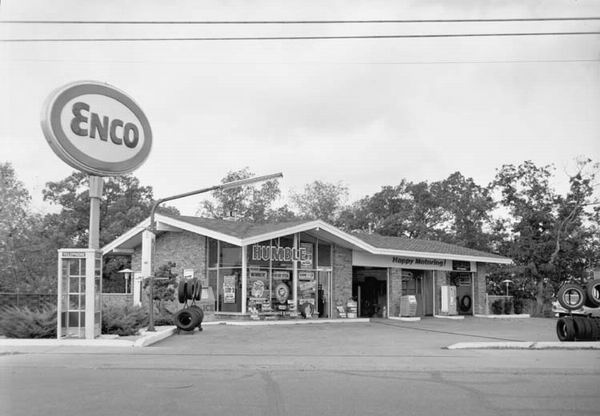
Enco Gasoline


The East Coast had Esso gas stations. For those who don't know, Esso stood for the letters "SO," as this was formerly the Standard Oil Company of New Jersey. In California, Texas, Michigan, and even Florida (isn't that on the East Coast?), as well as some other places, we had Enco. It was the same Humble Refining Company that owned it. Actually, I found out that the company was not allowed to use the Esso name in certain jurisdictions, so they used Enco.

What did the name stand for? Who knows?

Enco, like Esso, had the free road maps that folded differently than any other gas station. I used to collect maps like that. It was neat. I had hundreds. Today kids have to buy those things!

I do remember that in 1969 the Enco acquired the Signal gasoline company. There was a service station in my neighborhood owned by a man named Elso. He owned a Signal gas station located in front of Jay's Country Boy Market. As a Signal retailer, it was simply, "Elso's Service." When the company became Enco, the station was now Elso's Enco. Cute. A few years later, when Enco became Exxon, the station became Elso's Exxon.

But, even that gas station is gone. It was bulldozed to make a bigger parking lot for Jay's Country Boy. And now, even Jay's Country Boy is gone.

Thriftimart

Those of us who grew up in Southern California in the 1960s remember the big Ts sticking up at most shopping centers. We had one in Colton, at the Mount Vernon Shopping Center. The T itself was an amazing thing. We never thought the day would happen that all those Ts would be taken down and the chain would go out of business.

The chain was actually one of the newer ones, having been started in 1952--actually it was part of a chain known as Fitzsimmons, which started in 1930. It didn't last, though.

The chain went out of business in 1984, though most of the stores were long gone before that time.

Ecuadorian Sucres

You really have to feel sorry for the Republic of Ecuador. The country has gone through its share of coups de etat and other problems. It was the first really poor country I ever visited/lived in. I saw things that I never thought existed anywhere.

Most Americans who know about radio communications know about HCJB, the Voice of the Andes. I spent some time there, mostly getting in missionaries' ways. But, being fluent in Spanish, I could get everyone a bottle of Coke at 3:00 in the afternoon.

When I was there the exchange rate for the sucre (the Ecuadorian former monetary unit) was 100:1. That was 1983. I kept watching that number get higher and higher over the years. This 10,000 sucre note you see on this page, issued in 1988, would probably just buy a bottle of Coke.

In 2001, Ecuador gave up with the sucre and the U.S. dollar (or dolar estadosunidense) became the legal tender. At least you don't have to go to a money changer there now.