Friday, March 27, 2009

Brew 102


It was the cheapest beer you could get. Most of us from the Los Angeles area knew this was the big brewery across the freeway from Los Angeles Union Station.

I was too young to drink the stuff, so I can't tell you what it was like. I do remember all those cans. My grandfather loved it. He was an alcoholic who drank beer for breakfast, wine for lunch, and the hard stuff for supper... He did get on the wagon and lived the last 15 years of his life soberly, though he died of cirrhosis.

Now that I drink beer myself, I've always been curious how this Brew 102 tasted.

Atchison, Topeka, and Santa Fe Railway

My dad went to work for the Santa Fe Railway in 1961. Historically, that's interesting because the railroad was started 98 years before by Cyrus K. Holliday. But we're not really into that kind of history on this site because that has very little to do with anything that happened later.

The railroad was a good job for a family man. One of the fringe benefits was a passenger train pass. When we lived in San Diego (and Oceanside, about 40 miles north) we often took a trip to Los Angeles Union Station. We'd walk to Chinatown to Philippe's Original to have a French dip sandwich. Then we'd ride home. Olvera Street is across from there. We lived in San Diego until 1962 and then in Oceanside until 1966, when we moved to Colton. Colton, which is near San Bernardino, is close enough to drive in less than an hour.

In 1971, passenger service was stopped on all major U.S. mainland railroads, with the exception of the Denver, and Rio Grande Western, and the Southern Railway. Eventually, those two railroads gave in (and actually faded away, as they were absorbed by the Union Pacific and Norfolk and Western lines). Watching the new trains of Amtrak was fun at that time, since they hadn't bought or repainted any of the rolling stock. It was sad in that there used to be seven trains (or more) between Los Angeles and Chicago. Today there are only two. A few years ago, there were three, with the Desert Wind going through Las Vegas, Nevada, and Salt Lake City, where it hooked up with the California Zephyr.

My dad had his problems with the railroad, as well as his health. He retired at the age of 63 in 1990 and died in 2007.

The Santa Fe Railroad died in 1995 when it merged with Burlington Northern.

So much for old Johnny Mercer songs!

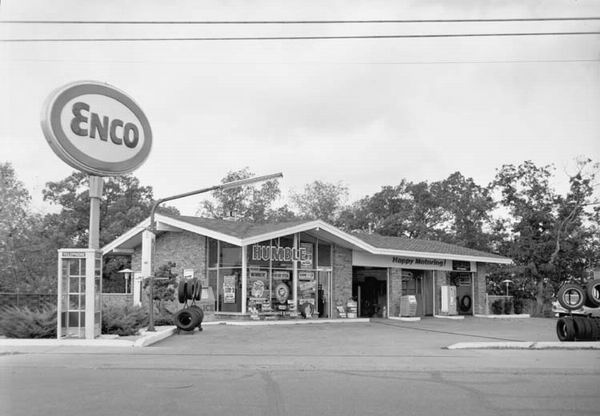
Enco Gasoline


The East Coast had Esso gas stations. For those who don't know, Esso stood for the letters "SO," as this was formerly the Standard Oil Company of New Jersey. In California, Texas, Michigan, and even Florida (isn't that on the East Coast?), as well as some other places, we had Enco. It was the same Humble Refining Company that owned it. Actually, I found out that the company was not allowed to use the Esso name in certain jurisdictions, so they used Enco.

What did the name stand for? Who knows?

Enco, like Esso, had the free road maps that folded differently than any other gas station. I used to collect maps like that. It was neat. I had hundreds. Today kids have to buy those things!

I do remember that in 1969 the Enco acquired the Signal gasoline company. There was a service station in my neighborhood owned by a man named Elso. He owned a Signal gas station located in front of Jay's Country Boy Market. As a Signal retailer, it was simply, "Elso's Service." When the company became Enco, the station was now Elso's Enco. Cute. A few years later, when Enco became Exxon, the station became Elso's Exxon.

But, even that gas station is gone. It was bulldozed to make a bigger parking lot for Jay's Country Boy. And now, even Jay's Country Boy is gone.

Thriftimart

Those of us who grew up in Southern California in the 1960s remember the big Ts sticking up at most shopping centers. We had one in Colton, at the Mount Vernon Shopping Center. The T itself was an amazing thing. We never thought the day would happen that all those Ts would be taken down and the chain would go out of business.

The chain was actually one of the newer ones, having been started in 1952--actually it was part of a chain known as Fitzsimmons, which started in 1930. It didn't last, though.

The chain went out of business in 1984, though most of the stores were long gone before that time.

Ecuadorian Sucres

You really have to feel sorry for the Republic of Ecuador. The country has gone through its share of coups de etat and other problems. It was the first really poor country I ever visited/lived in. I saw things that I never thought existed anywhere.

Most Americans who know about radio communications know about HCJB, the Voice of the Andes. I spent some time there, mostly getting in missionaries' ways. But, being fluent in Spanish, I could get everyone a bottle of Coke at 3:00 in the afternoon.

When I was there the exchange rate for the sucre (the Ecuadorian former monetary unit) was 100:1. That was 1983. I kept watching that number get higher and higher over the years. This 10,000 sucre note you see on this page, issued in 1988, would probably just buy a bottle of Coke.

In 2001, Ecuador gave up with the sucre and the U.S. dollar (or dolar estadosunidense) became the legal tender. At least you don't have to go to a money changer there now.

Thursday, March 26, 2009

Warner Brothers Studio Store

This was a souvenir shop where clothing, toys, office supplies, and other paraphernalia with pictures from Warner Brothers, Hanna-Barbera, MGM, and DC Comics (including Mad Magazine) could be purchased. It began in 1986 selling a few books and toys. The stores grew and became a huge chain. It soon spread to Asia, Australia, and Europe.
In 2001, the entire chain went out of business in the United States and in 2004 overseas (there might be a few left).
In 2006, the chain was reborn in China. There are now outlets in Hong Kong and Macau.
For those of us not living in those areas, there is this site.

Burger Chef


It started in 1954 in Indianapolis and became number 2 to McDonald's in a short time. Frank and Donald Thomas created an inside Flame Broiler to make barbecued hamburgers indoors. The idea became quite popular and spread to the East and West Coasts.
They were the first chain to sell hamburgers without condiments so that customers could make their sandwiches the way they wanted them. This is still used in the Roy Rogers chain.
The company was purchased by General Foods in 1968.
They were the first chain to offer a child's meal, which they called the Fun Meal. When McDonald's introduced the Happy Meal, Burger Chef tried to sue but lost in 1979.
In 1982, General Foods sold the chain to the folks that run Hardee's.
For all intents and purposes, Burger Chef went out of business in 1992. However, one outlet in Cookeville, Tennessee, was able to stay Burger Chef until 1996. The name was changed to Pleaser's and it went out of business in 2002.

Plymouth


The Plymouth Division of Chrysler Motors began July 7, 1928. It was to be the competition to Chevrolet (General Motors) and Ford.
For most of the time of Plymouth's existence, the line was nothing more than stripped, cheap (you know you never use that term in advertising!) versions of the more impressive Chryslers. It was also in the shadow of Dodge, which Chrysler bought a few weeks after the inception of Plymouth.
Plymouth eventually got some of its own livery, however it was not always looked as favorably as history makes it look.
Probably the best thing the company did was link arms with Warner Brothers cartoons to create the Road Runner sports car in the late 1960s. The Barracuda was also a very favorably received vehicle.
But many of its line were low priced versions of Chryslers. The last successful Plymouth was the PT Cruiser (PT for "panel truck"). Marketed as a Chrysler outside the United States, after the division died, it became a Chrysler soon thereafter.
Plymouth died after the 2001 model year.

Berlin Wall


It was erected three days after my fourth birthday around the city of West Berlin. It seems that the freedom of access between East Berlin (as well as surrounding communities of the German Democratic Republic) and West Berlin was threatening the surrounding nation's survival.
The Berlin Wall was a very important part of my life. From October 1979 until January 1982 I was one of the Allied service members who guarded the sanctity of the free world in West Berlin. Never mind that I was just a tuba player with the 298th Army Band, but I was there and it made me very proud and proud of my country to do what I was doing there.
The Wall came down on October 9, 1989, eight days after the birth of my second daughter.

PEOPLExpress


It was a tremendous idea. You could fly from Newark (which is actually closer to Manhattan than John F. Kennedy International Airport) to Los Angeles for almost nothing. Prices for this route would range from $29.95 (if you didn't mind flying in the middle of the week at 3:00 AM) to $149.95 for a normal day flight. Checked baggage was $3.00 per item (they were the first airline to make this charge.


Then there was the menu. Food service was not free. A can of soda pop was 50 cents. A brownie was 50 cents. Even a bag of peanuts was 50 cents. It was not unusual to see passengers bring lunchboxes on board.
One of the secrets to how this airline was able to do things so inexpensively was that fares were collected in the air. There was a cashier at the terminal who checked that passengers had cash or valid credit cards (with enough money on them). Then these were collected once the plane leveled out.
Known as Greyhound of the air, PEOPLExpress's terminal at Newark (New Jersey) International Airport looked like a Post House in the middle of the United States.
The airline started in 1981 and was bought out by Continental Airline in 1987. It didn't go broke, as some folks may have thought. This was an idea that worked but it had the competitors scared to death!